Fachsprachprüfung (FSP) in Germany: Complete Guide for International Doctors
Updated for 2026
If you are an international medical graduate planning to work as a doctor in Germany, one of the most important steps in the licensing process is the Fachsprachprüfung (FSP) — the German medical language examination.
The FSP is designed to determine whether you can communicate safely and professionally in German in typical clinical situations: speaking with patients, communicating with colleagues and documenting medical information.
For many international doctors, passing the FSP is an important milestone on the road to obtaining Approbation or, where applicable, a Berufserlaubnis.
However, the registration process is not identical throughout Germany. The responsible authority, registration route, examination fee, documentation and waiting time can vary depending on the Bundesland and the authority handling your application.
This guide explains the FSP process in a simple, step-by-step format and highlights the points international doctors should check before submitting their application.
Quick Answer: What is the Fachsprachprüfung?
The Fachsprachprüfung, commonly abbreviated as FSP, is a professional German-language examination for internationally trained doctors.
It assesses your ability to use German in realistic medical situations, including:
- Taking a patient’s medical history
- Communicating with patients in understandable language
- Explaining medical investigations and treatment
- Discussing a patient with another doctor
- Using appropriate medical terminology
- Writing medical documentation
- Structuring and communicating clinical information clearly
The examination is generally oriented towards C1-level medical communication, while applicants are commonly expected to demonstrate general German language proficiency at B2 level before proceeding to the specialist-language examination. The exact requirements depend on the responsible authority and federal state.
Why Do International Doctors Need the FSP?
A German medical degree is not the only requirement for practising medicine in Germany.
Doctors who obtained their medical education outside Germany generally have to go through the relevant professional recognition and licensing procedure.
The Approbation is the unrestricted German licence to practise medicine. A Berufserlaubnis is a temporary professional licence and can be subject to restrictions, including restrictions relating to the federal state or place of employment.
Language competence is an important part of this process because doctors must be able to communicate safely with patients and healthcare professionals.
The FSP therefore focuses specifically on medical communication rather than testing your entire medical knowledge.
For example, in the FSP you may be expected to:
Take a structured history, explain your assessment to a patient, document the case and subsequently present the patient to another doctor.
This is very different from simply demonstrating that you know German vocabulary.
FSP vs B2 German: What Is the Difference?
This is one of the most common sources of confusion.
B2 German
A general German B2 certificate demonstrates your general German language ability.
Depending on the Bundesland and authority, certificates from recognised providers such as Goethe, telc or other accepted examinations may be relevant.
Fachsprachprüfung / Medical C1
The FSP evaluates whether you can use German effectively in the medical workplace.
You therefore need more than general vocabulary.
You should be comfortable with:
- Anamnesis
- Symptoms and complaints
- Medical history
- Medication
- Allergies
- Examination findings
- Differential diagnoses
- Investigations
- Treatment plans
- Risk explanations
- Clinical documentation
- Doctor-to-doctor communication
The Bundesärztekammer states that sufficient general German proficiency is typically required, commonly around B2, while the medical language examination generally corresponds to approximately C1 in the medical field.
Who Usually Needs to Take the FSP?
The FSP is primarily relevant to internationally trained doctors seeking medical professional recognition in Germany.
It is particularly relevant if:
- Your medical degree was obtained outside Germany.
- You are applying for Approbation.
- You are applying for a Berufserlaubnis.
- The competent authority determines that a medical language examination is required.
- Your existing language evidence does not satisfy the specific requirements of your Bundesland.
There can be exemptions or alternative arrangements in individual circumstances.
Therefore, do not assume that a B2 or C1 certificate automatically eliminates the FSP. The responsible authority determines what evidence is accepted in your particular case.
The Most Important Point: FSP Registration Is NOT the Same Everywhere
Germany has 16 federal states (Bundesländer), and the administrative pathway for internationally trained doctors can differ between them.
In many states, you do not simply contact the Ärztekammer and book an FSP yourself.
Instead, the process may look like this:
Medical qualification → Approbation/Berufserlaubnis application → document review → authority determines FSP requirement → referral/registration with Ärztekammer → payment → examination date
In other states, candidates may need to submit an additional registration to the relevant medical chamber after receiving confirmation from the licensing authority.
This distinction is extremely important.
For example:
North Rhine-Westphalia
For the North Rhine area, the responsible Bezirksregierung processes the Approbation application. Once the authority has reviewed the application and determines that an FSP is required, the necessary information is transferred to the Ärztekammer Nordrhein.
The applicant does not normally need to register personally at the chamber. The chamber then contacts the applicant and requests payment of the examination administration fee before allocating an examination date.
Bavaria
In Bavaria, direct registration with the Bayerische Landesärztekammer is not possible. Candidates are transmitted to the medical chamber through the responsible recognition authority.
The BLÄK currently lists a €550 administration fee for the FSP.
Thüringen
Thüringen provides a different route. Applicants submit the FSP registration electronically and provide documents including:
- B2 German certificate
- CV
- Confirmation that the Approbation application has been received
- Identification document
- Visa copy where applicable
The current listed FSP fee is €600.
The lesson: never rely on another doctor’s registration process from a different Bundesland without checking the current rules of your own authority.
Step-by-Step: How to Register for the Fachsprachprüfung
Step 1: Choose the Bundesland Where You Intend to Practise
Your first major decision is identifying the federal state responsible for your licensing application.
The competent authority depends on your circumstances, including where you intend to work or, where applicable, where you live.
The Bundesärztekammer explains that the authorities responsible for Approbation and Berufserlaubnis are located at state level.
Important
Do not choose a Bundesland solely because someone tells you that its FSP is “easier” or “faster”.
Instead, verify:
- Jurisdiction
- Recognition requirements
- Registration procedure
- Language certificate requirements
- Current waiting time
- Examination fee
- Documentation requirements
- Whether local residence or employment affects the process
Step 2: Start Your Approbation or Berufserlaubnis Application
In many cases, the FSP forms part of the wider medical licensing procedure.
You will usually need to submit an application to the competent Approbationsbehörde.
Depending on your country of medical education and individual circumstances, documents may include:
- Passport or identity document
- Medical degree
- Medical transcript or evidence of training
- Curriculum vitae
- Evidence of professional experience
- German language certificate
- Certificate of good standing
- Police clearance documentation
- Medical fitness certificate
- Certified translations
- Other documents requested by the authority
The exact checklist differs according to the Bundesland and whether your medical qualification comes from the EU/EEA/Switzerland or a third country.
The Bundesärztekammer confirms that internationally trained doctors require either Approbation or, in certain circumstances, Berufserlaubnis to practise medicine in Germany.
Step 3: Submit Your German Language Evidence
A general German language certificate is usually an important component of the application.
A B2-level certificate is commonly required or recognised as evidence of general German proficiency.
However, the precise certificate requirements vary.
Do not assume that:
“I have B2 = I have completed the FSP requirement.”
These are different stages.
Think of the process as:
General German
B2 → general communication
↓
Medical German
FSP → professional medical communication
↓
Licensing
Approbation / Berufserlaubnis
Step 4: Wait for the Authority to Review Your Application
Once your application has been submitted, the competent authority reviews your documentation.
This stage is important because the authority may determine:
- Whether your application is complete
- Whether your medical qualification is recognised or requires further assessment
- Whether you need an FSP
- Whether additional documents are required
- Which examination authority is responsible
Do not confuse the FSP with the Kenntnisprüfung.
They serve different purposes.
FSP
Tests medical German communication.
Kenntnisprüfung
Tests medical knowledge and clinical competence where required as part of the recognition process.
The Bundesärztekammer describes the Kenntnisprüfung as an examination addressing medical knowledge, including internal medicine, surgery and other relevant areas.
Step 5: Receive Instructions for FSP Registration
Once the responsible authority determines that an FSP is required, the next step depends on the Bundesland.
You may:
- Be automatically referred to the Ärztekammer.
- Receive instructions to register with the Ärztekammer.
- Need to submit an additional registration form.
- Need to provide your B2 certificate and other documents.
- Receive a payment request before your examination date is allocated.
This is why there is no single Germany-wide FSP registration form.
Always follow the instructions from your competent authority.
Step 6: Pay the FSP Examination Fee
FSP fees are not nationally standardised.
They vary according to the responsible examination body.
For example:
- Bavaria: currently €550 according to BLÄK.
- Thüringen: currently €600.
- North Rhine: Ärztekammer Nordrhein currently lists €430.
These amounts can change, so candidates should verify the current fee directly with the relevant authority before making payment.
Step 7: Receive Your Examination Date
After the necessary documents have been submitted and the required fee has been paid, the examination authority allocates an appointment.
Waiting times can vary significantly.
For example, the current BLÄK information indicates that waiting times have recently been reduced to approximately four to six weeks under its current arrangements, while other regions may have substantially different timelines.
Thüringen currently states that candidates should expect approximately three to four months from application to examination.
Therefore, statements such as “the FSP always takes three months” or “Bavaria is always faster” should be treated cautiously.
Waiting times are dynamic.
What Does the Fachsprachprüfung Actually Test?
The exact format can vary slightly between examination bodies, but the FSP is designed around realistic clinical communication.
A common structure consists of three major components:
1. Arzt-Patienten-Gespräch
Doctor–patient conversation
You conduct an anamnesis with a simulated patient.
You may need to:
- Introduce yourself
- Confirm the patient’s identity
- Ask about the presenting complaint
- Clarify symptoms
- Explore past medical history
- Ask about medication
- Ask about allergies
- Explore social and family history
- Ask appropriate follow-up questions
- Explain your preliminary assessment
- Discuss further investigations
- Explain treatment or next steps
The critical skill is not simply asking questions.
You must communicate clearly and appropriately for the patient.
2. Dokumentation
Medical documentation
You convert the information obtained during the patient interview into appropriate written medical documentation.
You should be able to:
- Organise information logically
- Use appropriate medical terminology
- Write grammatically understandable German
- Distinguish relevant from irrelevant information
- Record symptoms and findings accurately
- Produce a concise clinical summary
3. Arzt-Arzt-Gespräch
Doctor-to-doctor communication
You then communicate the clinical information to another medical professional.
This requires a different style of language.
With a patient:
verständlich + patient-friendly
With another doctor:
medizinisch präzise + structured + Fachsprache
You may need to present:
- Patient identity
- Chief complaint
- Relevant history
- Examination findings
- Investigations
- Differential diagnosis
- Working diagnosis
- Proposed management
- Relevant risks or complications
The Ärztekammer Nordrhein describes a 60-minute examination divided into three 20-minute sections: doctor–patient communication, documentation and doctor–doctor communication.
Thüringen similarly describes three 20-minute sections and states that the examination is oriented towards C1-level professional language.
Is the FSP a Medical Knowledge Exam?
No — not in the conventional sense.
This is a crucial point.
The FSP primarily evaluates your language and communication skills in a medical context.
For example, Ärztekammer Nordrhein explicitly states that the examination concerns specialist language rather than basic medical knowledge.
That does not mean medical knowledge is irrelevant.
You still need enough clinical understanding to communicate naturally about:
- Symptoms
- Diagnoses
- Investigations
- Treatment
- Clinical findings
But the central question is whether you can communicate these concepts appropriately in German.
What Makes the FSP Difficult?
Many doctors discover that passing B2 German does not automatically mean they are ready for the FSP.
The difficulty often comes from switching between three communication modes:
Patient language
“Wo genau tut es weh?”
Medical terminology
“Der Patient berichtet über thorakale Schmerzen.”
Professional presentation
“Bei dem Patienten bestehen seit etwa zwei Stunden retrosternale Schmerzen mit Ausstrahlung in den linken Arm.”
A successful candidate must know when to use each level of language.
How Should You Prepare for the FSP?
1. Stop Studying German Only From Textbooks
Traditional grammar study is useful, but it should not be your entire preparation.
The FSP is highly practical.
Practise speaking.
Practise listening.
Practise documenting.
Practise presenting patients.
2. Build a Medical German Vocabulary
Create vocabulary groups rather than memorising isolated words.
For example:
Cardiovascular
- Brustschmerzen
- Atemnot
- Herzklopfen
- Schwindel
- Synkope
- Blutdruck
- Herzfrequenz
- Herzinfarkt
- Herzinsuffizienz
- Vorhofflimmern
Gastrointestinal
- Übelkeit
- Erbrechen
- Durchfall
- Verstopfung
- Bauchschmerzen
- Blut im Stuhl
- Sodbrennen
Neurology
- Kopfschmerzen
- Taubheitsgefühl
- Lähmung
- Sprachstörung
- Bewusstseinsstörung
- Krampfanfall
3. Practise Patient-Friendly German
One of the most important skills is translating medical terminology into language a patient understands.
For example:
Hypertonie
→ “Bluthochdruck”
Dyspnoe
→ “Atemnot oder Luftnot”
Cephalgie
→ “Kopfschmerzen”
Ödem
→ “Wassereinlagerung bzw. Schwellung”
The FSP is not simply about demonstrating that you know complicated medical terminology.
It is about demonstrating that you can communicate safely with real patients.
4. Practise the Arzt-Arzt Presentation
Develop a consistent structure.
For example:
“Ich möchte Ihnen einen Patienten vorstellen…”
Then proceed systematically:
- Patient details
- Presenting complaint
- History
- Relevant medical history
- Medication
- Allergies
- Examination findings
- Investigations
- Differential diagnosis
- Working diagnosis
- Proposed management
A predictable structure reduces cognitive load during the examination.
5. Practise Documentation Under Time Pressure
Do not only practise speaking.
Write clinical summaries regularly.
Your goal should be:
accurate + structured + concise + medically appropriate
rather than producing unnecessarily complicated German.
6. Use Mock FSPs
Mock examinations are particularly valuable because the FSP is performance-based.
A good mock examination should reproduce:
- Time pressure
- Patient questioning
- Unexpected patient answers
- Documentation
- Doctor-to-doctor presentation
- Examiner questions
Practising alone is useful.
Practising with another person is better.
Practising repeatedly under realistic conditions is better still.
What Documents Should You Prepare?
The exact list varies by authority, but international doctors may commonly need some combination of:
- Passport/identity document
- Medical degree
- Academic transcript
- Curriculum vitae
- German language certificate
- Certificate of good standing
- Police clearance/official conduct documentation
- Medical certificate
- Evidence of professional experience
- Certified translations
- Proof of application for Approbation
- Residence or employment documentation where required
Important: Do not use a generic online checklist as your final document list.
Your competent Approbationsbehörde may request additional or differently formatted documents.
FSP in Different German States
The following table provides a practical overview rather than a substitute for the current official instructions of each state.
| Bundesland / Region | Typical administrative approach |
|---|---|
| North Rhine-Westphalia | Approbation application is processed by the competent Bezirksregierung; FSP process is initiated through the responsible authority/Ärztekammer |
| Bavaria | FSP candidates are transmitted to BLÄK through the recognition authority; direct registration with BLÄK is not available |
| Thüringen | Registration can be submitted electronically to Landesärztekammer Thüringen with specified supporting documents |
| Rhineland-Palatinate | FSP is organised by the Landesärztekammer on behalf of the state; the licensing authority remains central to the process |
| Berlin | The FSP is integrated into the Approbation process through the responsible Berlin authorities and Ärztekammer |
| Other Bundesländer | Procedures differ; applicants should follow the instructions of the responsible Approbationsbehörde and Ärztekammer |
For example, Rheinland-Pfalz states that its Landesärztekammer conducts the medical FSP on behalf of the Landesamt für Soziales, Jugend und Versorgung.
Berlin’s current information likewise links the Fachsprachentest to the Approbation procedure and specifies a medical C1-level specialist-language examination.
Does Passing the FSP Automatically Give You Approbation?
No.
Passing the FSP is an important language-related requirement, but it is not the same as receiving your medical licence.
Your Approbation application may also involve:
- Recognition of your medical qualification
- Verification of personal reliability
- Health/fitness requirements
- General German language requirements
- Professional documentation
- Equivalence assessment
- Potentially a Kenntnisprüfung
The Bundesärztekammer confirms that Approbation is the full licence to practise medicine in Germany and that professional recognition for qualifications obtained outside the EU/EEA/Switzerland can involve an equivalence assessment and, where substantial differences remain, a Kenntnisprüfung.
What Happens After You Pass?
After successfully completing the FSP, the examination body provides the relevant result/certificate according to its procedure.
Your licensing application then continues.
For example, Berlin instructs successful candidates to forward the FSP certificate to the responsible licensing authority so that the Approbation procedure can continue.
The exact next step depends on your individual recognition case.
What If You Fail the FSP?
Failing the FSP does not mean that your medical career in Germany is over.
The rules for repetition vary.
For example, Berlin states that the complete Fachsprachentest must be repeated and that individual components cannot be repeated separately; it also states that the number of attempts is not limited.
Bavaria provides its own procedure for repeat candidates and advises a preparation interval following an unsuccessful attempt.
Therefore, always follow the rules of your particular examination authority.
After an unsuccessful attempt, analyse specifically:
- Patient communication
- Grammar
- Medical vocabulary
- Listening comprehension
- Documentation
- Case presentation
- Fluency
- Pronunciation
- Organisation of information
Then prepare specifically for the weak areas rather than simply repeating the same study routine.
10 Practical Tips to Pass the FSP
1. Learn phrases, not just vocabulary
Memorise useful clinical sentence structures.
2. Practise speaking every day
Medical German improves through active use.
3. Learn patient-friendly alternatives
Know both the Fachbegriff and the everyday German expression.
4. Build a fixed presentation structure
A consistent structure helps you remain calm under pressure.
5. Practise documentation
Writing is an essential part of many FSP formats.
6. Record yourself
Listen for pronunciation, grammar and unnatural sentence construction.
7. Practise interruptions
Patients and examiners do not always follow your prepared script.
8. Avoid unnecessarily complicated German
Clear communication is more important than sounding sophisticated.
9. Practise with realistic clinical cases
Use common presentations such as:
- Chest pain
- Dyspnoea
- Abdominal pain
- Headache
- Dizziness
- Fever
- Back pain
- Palpitations
- Diabetes
- Hypertension
10. Check the current rules of your Bundesland
This is perhaps the most important administrative tip.
Rules, fees, waiting times and registration procedures can change.
FSP Preparation Checklist
Before your examination, ask yourself:
German
☐ Can I communicate comfortably at B2/C1 level?
☐ Can I understand different accents and speaking speeds?
☐ Can I explain medical terms in simple German?
Patient interview
☐ Can I take a complete anamnesis?
☐ Can I ask appropriate follow-up questions?
☐ Can I explain investigations clearly?
☐ Can I respond naturally to patient questions?
Documentation
☐ Can I write a structured medical history?
☐ Can I use appropriate Fachsprache?
☐ Can I summarise a case concisely?
Doctor-to-doctor communication
☐ Can I present a patient logically?
☐ Can I explain differential diagnoses?
☐ Can I discuss investigations and management?
☐ Can I answer follow-up questions?
Examination technique
☐ Have I completed several full mock examinations?
☐ Can I perform under time pressure?
☐ Do I know the exact procedure of my examination centre?
Frequently Asked Questions About the FSP
Is B2 German enough to pass the FSP?
Not necessarily.
B2 is generally associated with the general-language requirement, while the FSP assesses medical communication at approximately C1 level. You need to be able to apply German effectively in clinical situations, not merely hold a B2 certificate.
Is the FSP a medical knowledge examination?
Primarily, no.
It focuses on professional medical language and communication. Ärztekammer Nordrhein explicitly states that the examination assesses specialist language rather than basic medical knowledge.
Can I register for the FSP directly?
It depends on your Bundesland.
Some states or regions require the licensing authority to initiate the process, while others provide a registration route through the medical chamber after certain conditions have been met.
How much does the FSP cost?
There is no single Germany-wide fee.
Current examples include €430 in North Rhine, €550 in Bavaria and €600 in Thüringen, but fees can change. Always check the current official fee for your examination authority.
How long does it take to get an FSP appointment?
There is no single national waiting time.
Current official examples illustrate the variation: BLÄK currently reports approximately four to six weeks, while Thüringen reports approximately three to four months from application to examination.
Is an FSP passed in one Bundesland automatically recognised everywhere?
Do not assume automatic nationwide recognition.
Recognition of a previous FSP can be subject to the requirements of the authority handling your application. For example, Bavaria states that recognition of an FSP passed in another Bundesland is reviewed by its responsible recognition authority.
Can I work as a doctor before passing the FSP?
This depends on whether you qualify for a Berufserlaubnis and on the conditions imposed by the competent authority.
A Berufserlaubnis is different from full Approbation and can be limited in duration and scope.
What is the difference between FSP and Kenntnisprüfung?
The FSP tests professional medical German.
The Kenntnisprüfung tests medical knowledge and clinical competence when required as part of the recognition process.
They are therefore two different examinations serving different purposes.
Your FSP Roadmap
For most international doctors, the process can be visualised as:
1. Choose your Bundesland
↓
2. Identify the competent Approbationsbehörde
↓
3. Submit your Approbation/Berufserlaubnis application
↓
4. Submit required German-language evidence
↓
5. Wait for document assessment
↓
6. Receive FSP instructions/referral
↓
7. Submit FSP documents
↓
8. Pay the examination fee
↓
9. Receive your examination date
↓
10. Take the Fachsprachprüfung
↓
11. Receive your result
↓
12. Continue the Approbation/recognition process
↓
13. Complete any additional requirements, including a Kenntnisprüfung if required
↓
14. Obtain your professional licence and begin your medical career in Germany
Final Advice for International Doctors
The FSP should not be approached as a conventional German examination.
Think of it as a clinical communication assessment.
You are demonstrating that you can:
listen → understand → question → explain → document → present → communicate safely
The most effective preparation therefore combines:
General German + Medical German + Clinical communication + Documentation + Mock examinations
And remember one important administrative principle:
Germany does not have one identical FSP registration process for every international doctor.
Your responsible Bundesland, Approbationsbehörde and Ärztekammer determine the details that apply to your case.
Always verify the current requirements directly with the competent authority before submitting documents or paying an examination fee.
Start Preparing for Your Fachsprachprüfung
If you are preparing for the German medical language examination, structured preparation can make the process much easier.
At London HeartbeatsZ Academy, we provide online medical education and professional learning resources designed for healthcare professionals, including international doctors preparing for career progression and professional practice.
Explore our medical education programmes and German medical-language preparation resources at HeartbeatsZ Academy.
Sources & Official Information
For the most reliable and current information, applicants should consult:
- Bundesärztekammer – information for international doctors
- The Approbationsbehörde responsible for your Bundesland
- The relevant Landesärztekammer
- Official FSP examination guidance for your examination centre
Requirements, fees, waiting times and administrative procedures can change, so official state-level information should take priority over older online guides.
SEO Title
Fachsprachprüfung (FSP) Germany 2026: Registration, Requirements & Exam Guide
Meta Description
Fachsprachprüfung (FSP) Germany 2026 guide for international doctors: registration, B2 requirements, C1 medical German, exam format, fees, waiting times, documents and preparation tips.
Suggested URL Slug
/fachsprachpruefung-fsp-germany-registration-guide
Primary SEO Keyword
Fachsprachprüfung Germany
Secondary Keywords
- Fachsprachprüfung FSP
- FSP Germany for doctors
- Fachsprachprüfung Anmeldung
- Fachsprachprüfung registration
- FSP exam Germany
- medical German exam Germany
- Fachsprachprüfung international doctors
- FSP Approbation Germany
- German medical language exam
- C1 Medizin Germany
- B2 German for doctors
- Approbation Germany for foreign doctors
- Fachsprachprüfung NRW
- Fachsprachprüfung Bayern
- Fachsprachprüfung Berlin
- Fachsprachprüfung Thüringen
- FSP preparation Germany
- medical German for doctors
- German licensing exam for doctors
Suggested Image SEO
File name:fachsprachpruefung-fsp-germany-international-doctors-guide.webp
ALT text:
Fachsprachprüfung FSP Germany step-by-step guide for international doctors
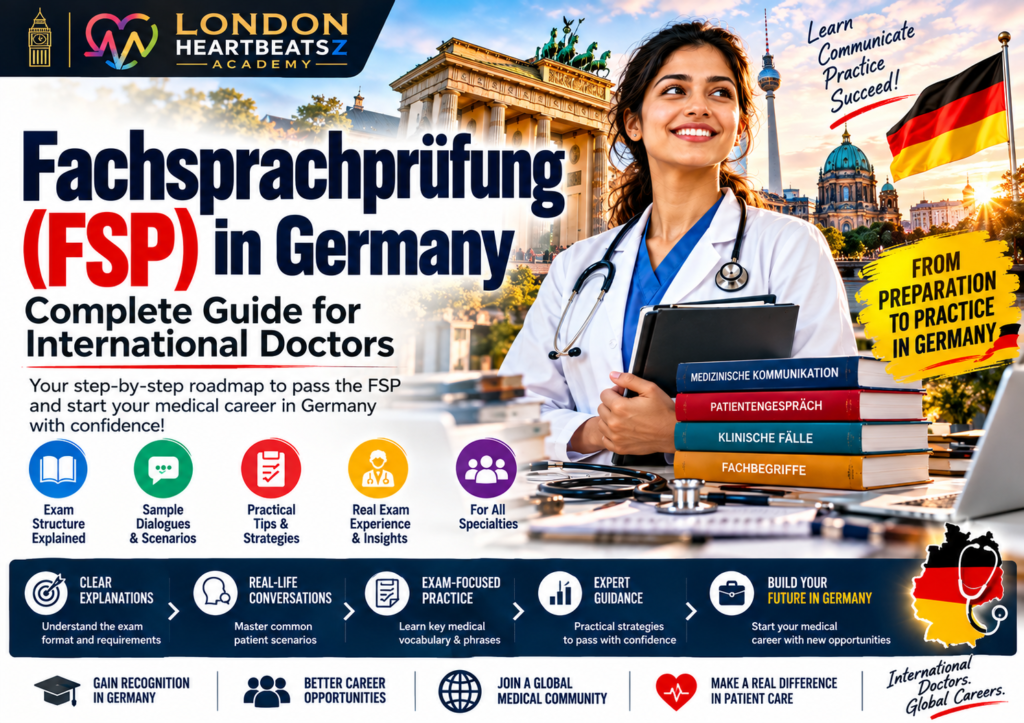
Image caption:
Fachsprachprüfung (FSP) in Germany: registration, examination and Approbation pathway for international doctors
Suggested Internal Links
Link naturally from this article to:
- Approbation in Germany
- Kenntnisprüfung Germany
- German Medical License for International Doctors
- Medical German / C1 Medizin
- FSP Preparation Course
- German Language Courses for Doctors
- Cardiology courses for international doctors
- Medical education programmes at London HeartbeatsZ Academy
Suggested FAQ Schema Questions
- What is the Fachsprachprüfung in Germany?
- Is B2 German enough for the FSP?
- What level of German is required for the FSP?
- How do I register for the Fachsprachprüfung?
- How much does the FSP cost in Germany?
- How long is the FSP examination?
- What happens if I fail the FSP?
- Is the FSP the same in every German state?
- Can I work in Germany before passing the FSP?
- What is the difference between FSP and Kenntnisprüfung?
- Is an FSP passed in another German state recognised?
- How should international doctors prepare for the FSP?
Related training for international doctors
Preparing for the Fachsprachprüfung and working in Germany? These courses cover the exam and the German you need for it.
- Master KP and FSP for International doctors in Germany
- Master German A1: Your First Steps to Everyday Conversation
- Master German A2: Turn Basic Words into Clearer Conversations
- Master German B1: Build Stronger Sentences and Speak with Confidence
- Master German B2: Make Complex Grammar Click
- Master German C1 Medical